Beyond the Hype: Decoding AI Agent Benchmarks for Your Truly Autonomous Personal AI

Beyond the Hype: Decoding AI Agent Benchmarks for Your Truly Autonomous Personal AI
The promise of personal AI agents is compelling: intelligent companions that seamlessly manage tasks, automate workflows, and even anticipate our needs. Yet, as the excitement around AI agents grows, so does the noise. Marketing claims can often blur the lines between a truly autonomous, reliable personal AI and a sophisticated chatbot. How do we, as users and enthusiasts, discern genuine capability from clever demonstration? The answer lies in understanding AI agent benchmarks.
These aren't just technical curiosities; benchmarks are critical for evaluating the true intelligence, autonomy, and reliability of the personal AI agents we entrust with our digital lives. They move us beyond superficial interactions to a deeper understanding of an agent's underlying capabilities.
Why Benchmarks are Crucial for Personal AI
Unlike traditional large language models (LLMs) that primarily focus on generating text, AI agents are designed to act. They perceive environments, reason, plan, execute tasks, and adapt. This fundamental difference means evaluating agents requires a much broader scope than simply assessing the quality of a single output.
For your personal AI, benchmarks are vital because they quantify:
- Reliability: Can your agent consistently perform tasks without unexpected failures?
- Autonomy: How independently can it operate, and when does it truly require human intervention?
- Robustness: How well does it handle variations, ambiguities, and unexpected scenarios in the real world?
- Efficiency: Is it completing tasks in a timely and cost-effective manner?
- Trustworthiness: Can you confidently delegate important tasks, knowing it will adhere to your intentions and safety parameters?
A personal AI agent isn't just about an impressive demo; it's about a consistent, dependable digital assistant that operates within your personalized environment, like those hosted on myHermy.
Key Capabilities Measured by Benchmarks
To understand an agent's true prowess, benchmarks assess several intertwined capabilities:
Reasoning and Planning
This goes beyond simple question-answering. Reasoning benchmarks evaluate an agent's ability to analyze complex problems, formulate multi-step plans, and adapt strategies when faced with new information. Benchmarks like ARC-AGI test for human-like fluid intelligence through novel visual puzzles that resist memorization. The reasoning layer of an agent involves planning tasks and creating strategies, with metrics often focusing on plan quality and adherence.
Tool Use and Integration
A truly autonomous personal AI needs to interact with the digital world. This means calling APIs, integrating with other applications (like your email, calendar, or smart home devices), and processing information from external sources. Benchmarks like API-Bank and ToolLLM specifically evaluate an agent's proficiency in selecting the right tools, generating correct arguments, and executing calls in multi-turn conversational settings. MetaTool, for instance, evaluates whether LLMs "know" when to use tools and can correctly choose from a set of options.
Autonomy and Long-Term Planning
Can your agent manage a complex project over days, weeks, or even months, making independent decisions and learning along the way? Autonomy scores, sometimes referred to as Human Intervention Rate, measure the ratio of actions taken autonomously versus those requiring human input. This is critical for agents designed to handle persistent, multi-step tasks. The "5 Levels of AI Agent Autonomy" framework highlights this spectrum, from basic human-led task execution to fully autonomous decision-making.
Reliability and Robustness
An agent that occasionally works isn't much use. Benchmarks now increasingly focus on an agent's ability to consistently perform and recover from errors. This includes tracking task completion rates, identifying specific failure modes (e.g., incorrect tool use, parsing errors), and evaluating performance under varied or ambiguous inputs. Some benchmarks like τ-bench reveal a "reliability crisis," showing that even top models can score below 50% success on multi-turn retail tasks, underscoring the gap between lab performance and real-world reliability.
Current Trends in AI Agent Evaluation
The landscape of agent evaluation is rapidly evolving to meet the demands of increasingly complex systems.
Shift to Dynamic, Interactive Environments
Traditional LLM benchmarks often rely on static datasets, which fall short for agents that interact with dynamic environments. Current trends favor interactive benchmarks that simulate real-world scenarios. Examples include:
- AgentBench: Evaluates LLMs across eight distinct interactive environments like operating systems, databases, and web browsing, with problems requiring 5 to 50 turns to solve.
- WebArena: Simulates web tasks in realistic domains like e-commerce and social forums, where agents must navigate browsers to achieve goals.
- τ-bench (TAU-bench): Designed for real-world reliability, it measures an agent's ability to interact with simulated users and programmatic APIs while adhering to domain-specific policies in multi-turn conversations.
- OSWorld-Verified: Assesses multimodal demands, combining visual grounding, operational knowledge, and multi-step planning across real operating systems.
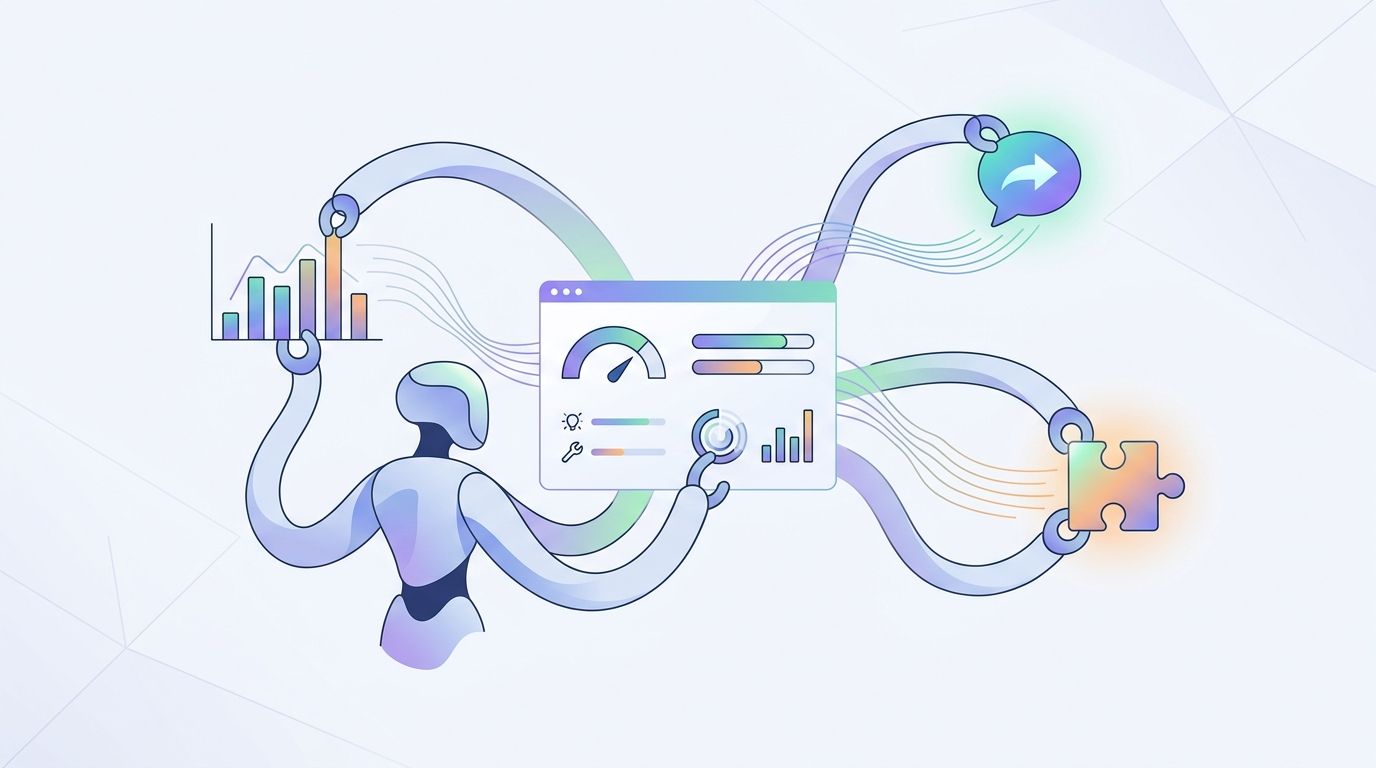
These benchmarks aim to capture the full "execution trace" of an agent, including every reasoning step, tool call, and intermediate decision, rather than just the final outcome.
Focus on Production-Readiness and Multi-Dimensional Metrics
There's a growing recognition that high benchmark scores in a lab don't always translate to reliable performance in production. New frameworks like CLEAR (Cost, Latency, Efficiency, Assurance, and Reliability) are emerging to address multi-dimensional assessment critical for deployment. Metrics now include operational factors like latency, token usage, and cost per task, which are crucial for scaling and managing an agent economically.
Limitations and Advancements in Evaluation
Despite significant progress, AI agent evaluation faces challenges:
The "Benchmark Game" and Contamination
One inherent limitation is the risk of models "overfitting" to benchmarks, meaning they perform well on specific tests but lack true generalizability. Also, widespread data contamination, where models may have been inadvertently trained on benchmark data, makes it difficult to trust leaderboard claims without full transparency on training corpora. This can create a "realism gap" between evaluation results and real-world tasks.
Difficulty in Capturing True Common Sense and Generalization
While benchmarks test specific skills, truly measuring "common sense" or generalized intelligence remains elusive. The ability of an agent to adapt to entirely novel situations, not just variations of seen tasks, is a frontier challenge. For example, ARC-AGI-3, launched in March 2026, sees frontier systems scoring below 1%, highlighting this gap.
Advancements Addressing Limitations
- Human-in-the-Loop Evaluation: Recognizing the probabilistic and non-deterministic nature of AI agents, human oversight and intervention become part of the evaluation process, measuring not just what the agent does, but when and how humans need to step in.
- Continuous Evaluation: Agent performance can degrade over time due to model updates, API changes, and data drift. Implementing continuous evaluation loops, including pre-deployment testing, shadow deployment, and production sampling, is becoming standard practice.
- Custom Benchmarking: Given the narrow coverage of many standard benchmarks, building custom evaluations tailored to specific use cases is increasingly recommended.
A Framework for Evaluating Your Personal AI Agent
As you consider deploying or customizing your personal AI agent, especially on platforms like myHermy, here's a practical framework to guide your evaluation:
- Look Beyond Raw Model Scores: A high score on a foundational LLM benchmark (like a general knowledge test) doesn't automatically mean strong agentic capabilities. An agent needs planning, tool-use, and reflective abilities, which are distinct. Focus on benchmarks specifically designed for agents, such as AgentBench, WebArena, or τ-bench.
- Prioritize Relevant Capabilities: Consider the core tasks you intend your personal AI to perform. If it's managing your calendar and email, prioritize benchmarks that measure tool-use accuracy and multi-step planning in those domains. If it's handling complex coding tasks, look at benchmarks like SWE-bench.
- Demand Transparency and Context: Understand how benchmark scores were achieved. Was human intervention allowed? What specific tools and environments were used? Proprietary systems sometimes lack the metadata needed for fair comparison.
- Emphasize Reliability and Error Handling: For a personal AI, consistent performance is paramount. Look for metrics beyond just task completion, such as error rates, failure modes, and robustness under perturbation. High-quality agents should also demonstrate "self-aware failures," recognizing their limitations and communicating them clearly or asking for human assistance.
- Leverage Your Platform's Flexibility: With myHermy, you get full root/SSH access and complete data ownership. This means you aren't locked into pre-defined evaluations. You can:
- Deploy and Test Iteratively: Experiment with different agent architectures and prompt engineering techniques relevant to your personal use cases.
- Implement Custom Monitoring: Set up your own logging and evaluation scripts to track performance, latency, and resource usage (like token consumption) in real-time, tailoring metrics to your specific needs.
- Control Your Data: Run private evaluations without concerns about data leakage or unintended exposure to external systems. This is especially important for sensitive personal information.
By applying these insights, you can navigate the complexities of AI agent evaluation and make informed decisions, ensuring your truly autonomous personal AI agent is genuinely capable, reliable, and aligned with your expectations, far beyond the marketing hype.