Beyond Buttons and Screens: How Your Personal AI Agent Is Rewriting the UI of Tomorrow

Beyond Buttons and Screens: How Your Personal AI Agent Is Rewriting the UI of Tomorrow
For decades, our interaction with technology has been defined by visible interfaces: command lines, graphical user interfaces (GUIs) with their myriad buttons and menus, and touch-based screens. Each evolution aimed to make technology more accessible and intuitive, yet still required us to learn and adapt to its specific design. Today, a profound shift is underway, one that promises to make these traditional interfaces fade into the background, replaced by a more natural, collaborative experience with our personal AI agents. This isn't just about better apps; it's about a future where the best interface is, arguably, no interface at all.
The Vanishing Interface: A Paradigm Shift
The concept of a "no UI" or "invisible UI" is gaining significant traction, suggesting that the most effective user interface is one that is invisible or doesn't explicitly exist. Instead of constant tapping, swiping, or clicking, users are increasingly interacting with technology through natural means like voice commands, gestures, or even automation that anticipates their needs. This movement aims to minimize friction and complexity, allowing technology to seamlessly integrate into our lives rather than demanding our constant attention.
Historically, user interfaces progressed from rigid command-line interfaces to more visually rich GUIs and then to the tactile world of mobile touchscreens. Each step made technology more approachable, yet users still bore the cognitive load of navigating structured menus and adapting to software. The current trajectory, however, points towards interfaces that feel less like "using technology" and more like engaging in a sophisticated, context-aware conversation with an intelligent entity.
From Direct Manipulation to Conversational Control
The advent of powerful AI, particularly large language models (LLMs) and advanced natural language processing (NLP), is driving this transformation. Modern AI interfaces can maintain complex conversations, understand nuance, and remember context across multiple interactions, moving beyond the limited capabilities of early voice assistants. This signifies a fundamental shift from menu-driven navigation to intent-based interaction, where users simply express their goals rather than needing to figure out the exact steps to achieve them.
This evolution is not merely about voice assistants getting smarter; it's about a broader adoption of Natural Language Interfaces (NLIs). NLIs allow users to interact with systems using spoken or written language, effectively removing the need for traditional menus, buttons, and complex navigation. As NLP technologies mature, systems can interpret not only intent but also context and even emotion, delivering a more personalized experience.
The Rise of the Personal AI Agent: Your Digital Delegate
At the heart of this shift is the personal AI agent. Unlike traditional software that requires humans to operate it, AI agents are designed to process data, make decisions autonomously, and adapt their actions based on feedback. They represent a move from interacting with software to delegating tasks to intelligent systems that can understand, reason, coordinate, and act on our behalf.
These agents are transforming task automation by handling activities that traditionally required human decision-making. They can process unstructured information from emails, documents, and images, and then take appropriate action, such as diagnosing a problem, classifying a request, or even providing a solution. This ability to move from passive interaction to purposeful action is what defines task-driven AI.
Beyond Buttons: How Delegation Reshapes Interaction
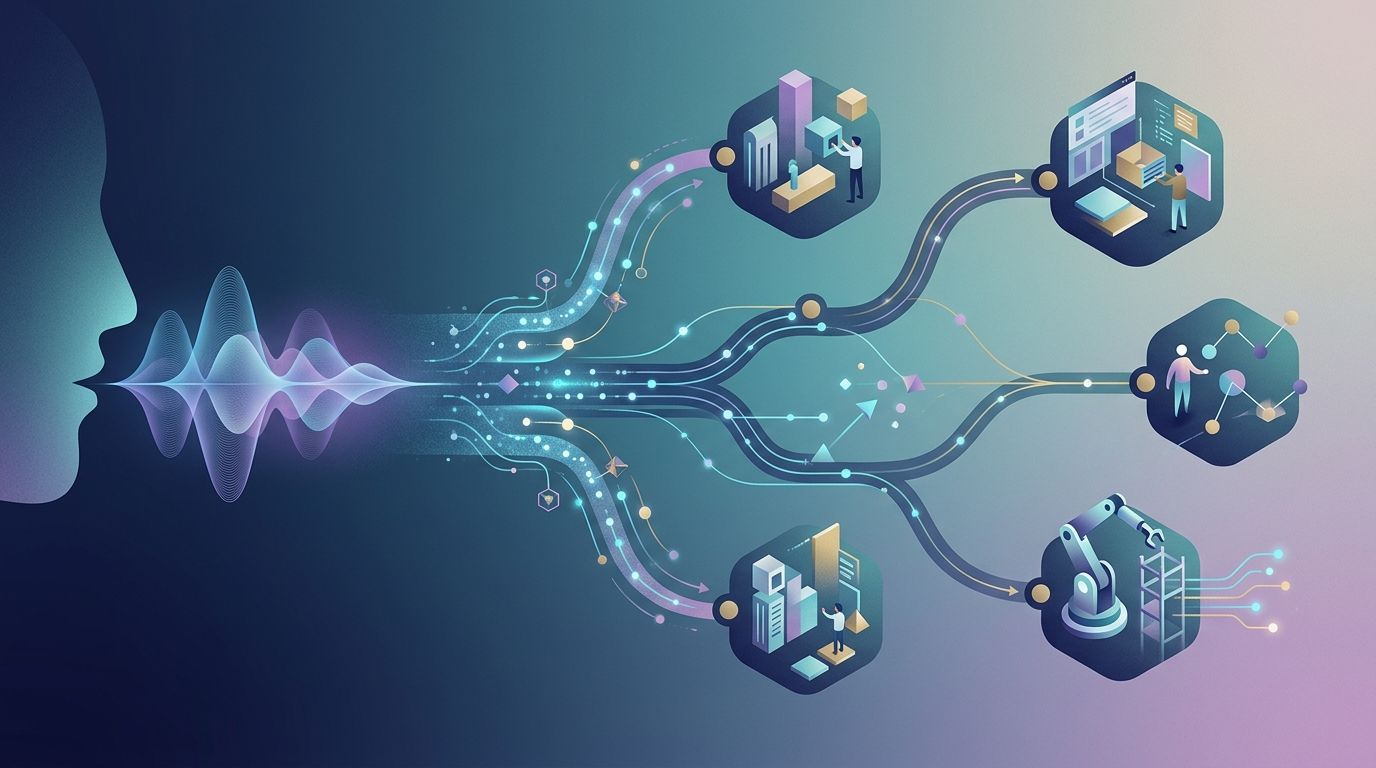
The transition to personal AI agents fundamentally redefines the user experience. Instead of meticulously clicking through menus or filling out forms, users will primarily interact with their agents through delegation and natural language. This means instructing your agent to "book a flight to London for next month within my budget" rather than navigating airline websites, entering dates, and filtering prices yourself. The focus shifts from how to do something to simply stating what needs to be done.
This delegation framework requires a new kind of trust and transparency. When an agent performs actions behind the scenes, the user loses visibility of the intermediate steps. Therefore, feedback mechanisms become crucial, providing summaries, confirmations, and explanations in place of visual cues. The UI doesn't disappear entirely; rather, it dematerializes, becoming ambient, conversational, and embedded within context, accessible through dialogue rather than dedicated screens.
myHermy's OpenClaw: Enabling Intelligent Collaboration
Platforms like myHermy are at the forefront of this evolution, empowering users to leverage personal AI agents in this new interaction paradigm. myHermy provides a dedicated VPS for your always-on personal AI agent, giving you full root/SSH access and complete data ownership. This secure and customizable environment is crucial for truly intelligent collaboration.
Consider myHermy's hypothetical 'OpenClaw' feature. OpenClaw acts as an advanced delegation engine, allowing your personal AI agent to interface seamlessly with various external services and platforms on your behalf. For example, instead of you directly managing API keys for different services, OpenClaw could enable your agent to:
- Connect Subscriptions: Integrate your existing ChatGPT Plus, Claude, GitHub Copilot, or Grok subscriptions. Your agent, powered by OpenClaw, can intelligently route queries to the most appropriate model based on your intent, without you needing to switch applications.
- Cross-Platform Communication: Reach your agent through diverse channels like Telegram, WhatsApp, Discord, Slack, and email. OpenClaw facilitates this multi-modal interaction, ensuring your agent is accessible and responsive wherever you communicate.
- Autonomous Task Execution: Delegate complex workflows. Imagine telling your agent, "Find me open-source projects related to quantum computing on GitHub, summarize the top five with the most recent activity, and send the summaries to my Slack channel." OpenClaw allows the agent to perceive, reason, and act across these different platforms, coordinating tasks and delivering outcomes without requiring you to manually browse each service.
This functionality moves beyond simple automation; it enables your agent to become an outcome-driven collaborator. It's about designing for what systems understand and do, rather than solely what users see.
Practical Takeaways for the Future UI
As personal AI agents rewrite the UI of tomorrow, here are some practical takeaways for users:
- Embrace Delegation, Not Just Automation: Learn to frame your requests in terms of desired outcomes rather than precise steps. Think about what you want your agent to achieve for you.
- Prioritize Clarity and Context: The more clearly you define your objectives and provide relevant context, the better your AI agent can perform. Just like with human team members, clear instructions are key.
- Demand Transparency and Control: While the interface might disappear, the need for oversight remains. Ensure your personal AI platform, like myHermy, provides ways to preview actions, approve consequential decisions, inspect reasoning, and reverse or correct outcomes.
- Leverage Centralized Control: Platforms like myHermy offer full root/SSH access and complete data ownership, which are paramount as your agent becomes more autonomous. This ensures you maintain ultimate control over your agent's data and operations.
- Think Beyond the Screen: Interactions with your personal AI agent will increasingly happen through natural language across various communication channels. The most important "interface" will be your ongoing conversation and collaboration with your agent.
Conclusion: Embracing the Invisible Interface
The era of traditional, button-and-screen-heavy interfaces is evolving. Personal AI agents are ushering in a future where our interaction with technology becomes more intuitive, seamless, and deeply integrated into our lives through delegation and natural language. While the "no UI" concept doesn't mean the complete absence of design, it signifies a shift in focus: from visible controls to intelligent outcomes.
Platforms like myHermy, with features designed to facilitate intelligent collaboration, are crucial for navigating this new landscape. By entrusting tasks to our personal AI agents, we free ourselves from the mechanical burden of direct manipulation, allowing us to focus on higher-level intentions and creative pursuits. The future UI isn't disappearing; it's transforming into a more powerful, personalized, and, often, invisible partner that works tirelessly on our behalf.